Niche Conservatism, Lability, and the Pace of Evolution
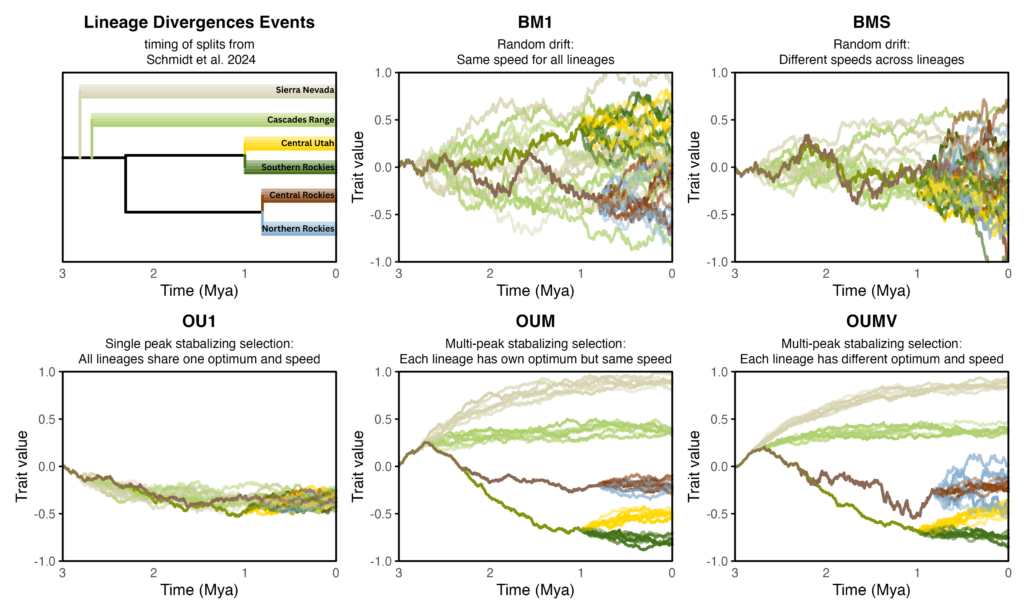
Phylogenetic comparative methods assess whether trait evolution looks like drift, selection toward one shared optimum, or selection pulling lineages toward distinct adaptive peaks, ultimately revealing whether a species’ niche behaves as a conserved constraint or a labile target over time. Niche conservatism predicts that related lineages retain similar climatic tolerances long after diverging geographically; adaptive radiation theory predicts the opposite. I’m interested in where empirical systems fall along this continuum, and at what taxonomic scale conservatism actually operates, since species-level analyses (or broader) can mask evolutionary structure that is otherwise hidden within genetically distinct lineages. What that structure means for a species’ capacity to adapt to a changing climate will be crucial for informing conservation planning as well.
Niche Theory and Species’ Range Limits
Under equilibrium niche theory, a species’ distribution should track its climatic niche through space; under non-equilibrium models, dispersal limitation, source-sink dynamics, and demographic lags should produce a measurable gap, a “climatic debt”, between where a species’ niche currently sits and where the species itself is found. My work tests these predictions directly, asking why populations of the same species so often diverge from both equilibrium and non-equilibrium expectations: some track climate closely, some lag behind it, and some do note appear to track shifting conditions altogether. I focus on various trait axes (thermal tolerance breadth, behavioral flexibility, and microhabitat buffering) that theory predicts should determine which regime a population falls into, and I explore forecasting approaches that use fine-scale abundance and distribution data to formally test niche-tracking models rather than assume they hold.

Communities, Species Interactions, & Climate Change
Community assembly theory predicts that as environmental filters shift, species sort into new communities according to trait-based rules: species whose functional traits match the new conditions are likely to persist or invade, while functionally mismatched species are filtered out. Climate-driven range shifts offer a natural experiment for this theory today, as they often generate novel communities in real time rather than over geological timescales. I’m interested in whether trait-based filtering, particularly in regards to thermal physiology and other tolerances, actually predicts who wins and who loses as communities shift, and what these outcomes reveal about the relative roles of environmental filtering versus biotic interactions in structuring montane communities under climate change. Because physiological tolerances vary widely across species, it offers a scalable, trait-based test of assembly theory that doesn’t require studying every species interaction in isolation.

Disturbance Theory and Genetic Consequences
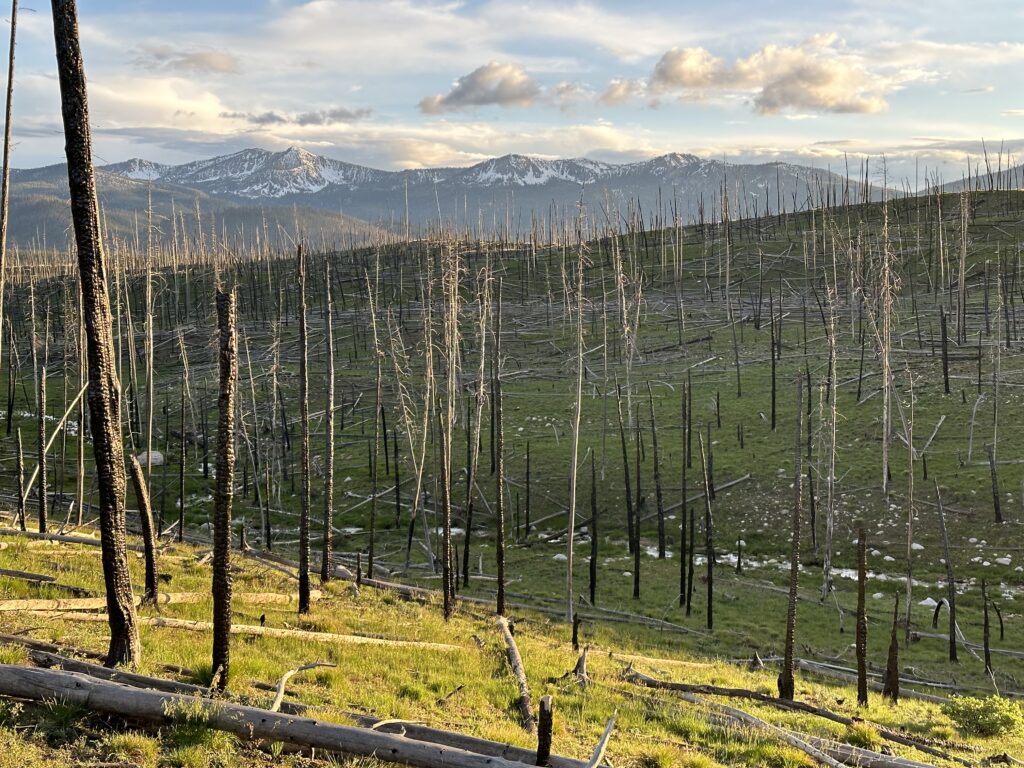
Disturbance ecology and metapopulation theory both suggest that persistence through disturbances depends on the availability of refugia, patches that somehow buffer populations from the full force of a disturbance and allow recolonization afterward. As wildfires intensify in size, severity, and frequency, refugia are expected to become more important, yet we still lack a clear picture of how species persisting within fire refugia are actually faring relative to expectations of resilience and recovery. My work uses long-toed salamanders and Columbia spotted frogs in recently burned wetlands across the Northern Rockies to test these ideas directly, examining how fire reshapes the aquatic habitat these species depend on and whether patterns of genetic diversity and trait diversity align with the predictions of refugia and metapopulation theory. Beyond these species, the aim of this work is to build a more general, theory-grounded idea of how disturbance regimes filter genetic diversity in natural systems, with particular relevance for sensitive species.